 Skip-the-line available
 The House of Bragança: from a Guimarães palace to the throne of Portugal
How an illegitimate son's manor in Guimarães became the seat of the family that would rule Portugal and Brazil — the story behind the Paço dos Duques.
To understand the Paço dos Duques de Bragança is to understand the family who built it. Their story runs from an illegitimate royal son in the 15th century to the last kings of Portugal in the 20th — and it begins in this palace in Guimarães.
Afonso, the first Duke
The founder of the line was Afonso, Count of Barcelos, the illegitimate son of King João I of Portugal and Inês Pires. Legitimised and richly endowed, he married into the powerful Nun'Álvares Pereira family, inheriting vast estates that made him the greatest landowner in the kingdom.
In 1442 the Regent Peter conferred on him the title of 1st Duke of Bragança — the first dukedom in Portugal not held by a member of the royal family itself — establishing a house that would shadow, and eventually inherit, the crown.
Building the palace in Guimarães
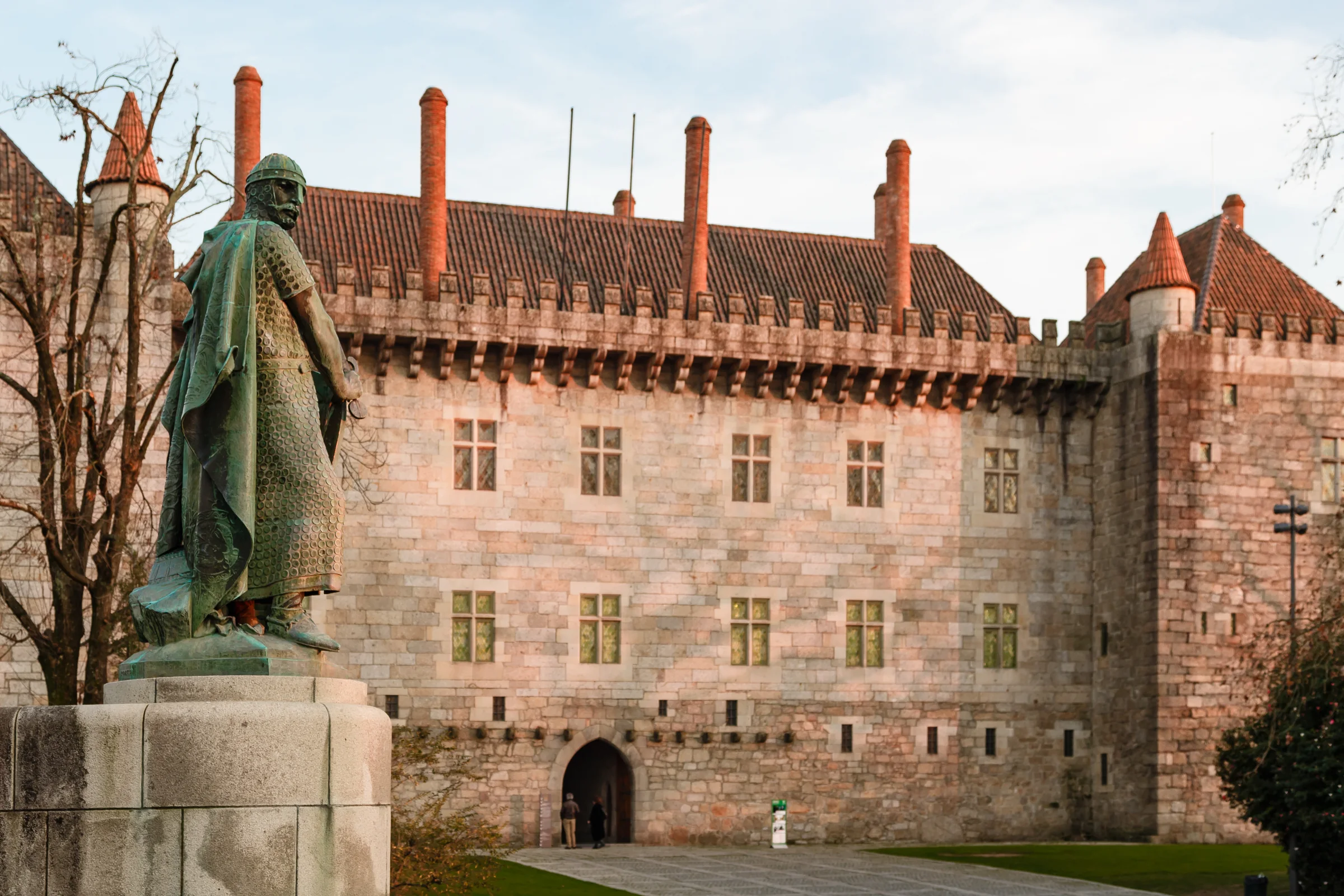
Afonso had travelled the courts of France, Venice, Aragon and Castile, and around 1420–1422 he began a residence in Guimarães that reflected those northern tastes: a Burgundian manor of steep roofs and tall brick chimneys, unlike anything else in Portugal. It was a statement of the new house's wealth and ambition, raised in the symbolic cradle of the nation.
His descendants extended it through the 16th century, but the family's centre of gravity was already shifting south.
The move to Vila Viçosa
During the 16th century the Dukes made the great palace at Vila Viçosa, in the Alentejo, their principal seat, and the Guimarães paço was left closed for long stretches — probably never fully completed. For centuries it slid towards ruin, quarried for its stone, while the dynasty's fortunes rose elsewhere.
That the palace survived at all to be reconstructed is, in a sense, an accident of the family's move away from it.
From dukes to kings: the Restoration of 1640
Portugal spent sixty years under the Spanish Habsburgs after 1580. In 1640 a group of nobles proclaimed the 8th Duke of Bragança king as João IV, ending the union and founding the Braganza royal dynasty. The family that had begun in a Guimarães manor now held the throne of Portugal — a throne it would keep until the monarchy fell in 1910.
The Braganças ruled through the age of empire, the Lisbon earthquake, the Napoleonic invasions and the country's fitful modernisation.
Emperors of Brazil
The dynasty's reach extended across the Atlantic. When the Portuguese court fled Napoleon to Rio de Janeiro, it set in motion Brazil's path to independence — and in 1822 a Braganza prince, Pedro, became the first Emperor of Brazil. For much of the 19th century, then, branches of the same family founded in Guimarães reigned on two continents.
The Brazilian empire lasted until 1889; the Portuguese monarchy until the revolution of 1910.
The palace's revival — and what you see today
Classified a National Monument in 1910, the ruined Guimarães palace was dramatically reconstructed under the Estado Novo regime from the late 1930s and turned into an official residence of the Portuguese Presidency in the north. That restoration is controversial — critics say it invented a grandeur the building never had — but it rescued the monument and made it visitable.
So when you walk the banquet hall and the tapestry rooms today, you are moving through the first home of a family that shaped six centuries of Portuguese and Brazilian history — reconstructed, reinterpreted, and returned to the city where it all began.
Frequently asked
Who were the Dukes of Bragança?
The most powerful noble house in Portugal, founded in 1442 with Afonso, illegitimate son of King João I. They became kings of Portugal in 1640 and later emperors of Brazil.
Is the House of Bragança still around?
Yes — the Braganza line continues as the former royal house of Portugal, though the monarchy itself ended in 1910. The current representatives are descendants of the royal branch.
Why is the palace in Guimarães if the family became royal?
Guimarães was the first Duke's residence in the early 15th century. The family later moved their seat to Vila Viçosa, and only inherited the throne in 1640 — long after the Guimarães palace was built.
Did the Braganças really rule Brazil?
Yes — a Braganza prince, Pedro, became the first Emperor of Brazil in 1822, and the family reigned there until 1889, a separate empire from the Portuguese kingdom.
How does this history shape a visit?
The palace is the physical starting point of the whole story — the first home of a dynasty that would rule two countries. Knowing that turns a walk through the rooms into a walk through the origins of modern Portugal.